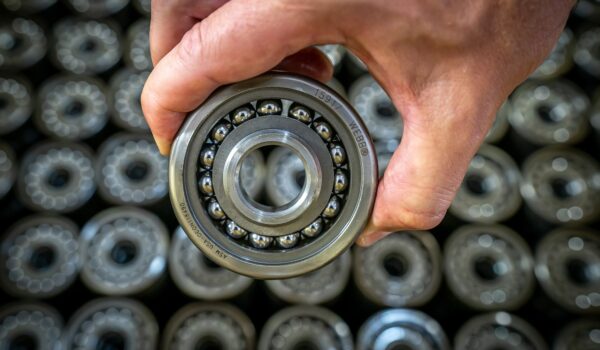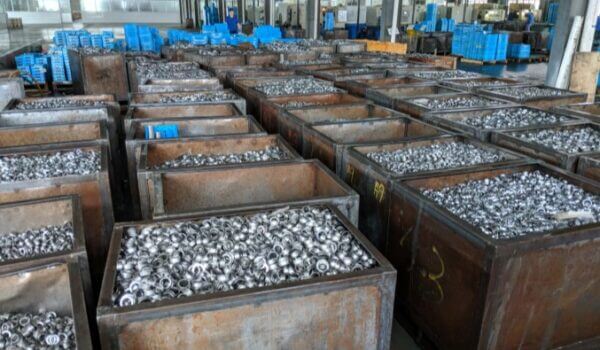
There’s no question that value should be among the top criteria OEMs consider when purchasing bearings for their applications. While a broad range of high quality options exist below the premium threshold, the point of diminishing returns is difficult to identify. If suppliers are continuously pressed for lower prices, the resulting savings eventually accompany trade-offs and risks buyers are not aware of and can’t afford. (Photo above: Tapered roller bearing rings awaiting further processing by a subcontractor in Jiangsu, China. With little to no visibility, the security of upstream and downstream inputs are a matter of trust.)
Beyond sound management, some bearing manufacturers choose to lower costs by cutting corners on design, materials, and/or processing. With luck, OEMs who utilize this product can avoid major product failures for a period of time. They may measure the associated impact in non-critical safety applications based on the level of statistical failures (returns, bad reviews, competitive positioning, etc.) and view it as an acceptable trade-off for higher margins.
Increasingly more damaging are the impacts to revenue and reputation from buying products with lower ESG (Environment, Social & Governance) standards such as pollution, exploited labor, fraud, and/or corruption. There is a real risk of losing customers, partners, and shareholders by ignoring these important criteria.
Here are five common mistakes bearing buyers make when looking to lower costs:
- Underestimating impacts from ESG risk (read more in this Jan 2021 OMCO SUMO article Lifting the Curtain on Chinese Bearing Manufacturing)
For most products, a major driver of price is often simply the geographical location where the product is manufactured. As bearing manufacturing facilities require a large amount of infrastructure, for those that have substantial investment in real estate and human capital in areas where costs are rapidly and exponentially rising, this leads to a greater reliance on outsourcing for requirements that historically were self-contained.
Just like in the US where it is cost prohibitive to set up manufacturing facilities in the middle of San Francisco or Manhattan, in China being competitive means moving further west (inland) or north to lower cost manufacturing centers. For bearings, two of the most important cities are Cixi (located in Zhejiang Province 120km south of Shanghai), and much lower cost Linqing (located in Shandong Province 420km south of Beijing). A small bearing factory in Shandong is commonly a rural home employing family members, part of a network of thousands of small workshops that either supply components to larger bearing manufacturers or sell through trading partners who then sell internationally.
Lower priced products often come with higher risks associated with that city or region. Is steel being sourced from responsible mills? How are workers being treated? Is the label or location of origination accurate? Relying on production from newer and lower cost manufacturing centers introduces more than quality and delivery risk. It also exposes end users to greater liability from ESG-related issues.
For more close to 100 years and similar to a US farmer’s market, small workshop bearing producers in Shandong have gathered here to show and exchange product, and to find work from trading companies.
2. Use of substandard steel and/or heat treatment
There are many ways to cut corners on steel quality resulting in lower cost, including substituting lower quality alloys, or using lower quality heat treatment. Annealing, for example, is one of the most important steps in determining bearing outer and inner ring integrity. Without proper annealing, internal tensions (stresses) remain in the ring, which can then deform or fracture.
There can be significant differences in quality level even within the same alloy specification such as AISI 52100, the most common chrome bearing steel. In more egregious circumstances, manufacturers may cut costs even further by substituting lower grade carbon steels which have far lower strength and wear resistance.
Combined with occasional power rationing made necessary due to inadequate supply and escalating material prices, these factors increase the risk of factories having to choose between alternative materials and sources or lost revenue. Thus, the likelihood of using lower quality steel that might be available becomes more of a concern.
3. Bypassing important finishing operations
Even if sound materials and heat treatment are utilized, demand for lower cost may yield products that were manufactured without important finishing processes that are unable to be detected without sophisticated and specialized laboratory equipment.
Some manufacturers willing to concede quality for revenue may make “precision” bearings without sufficient grinding or subsequent finishing operations. They may instead rely on turning and lightly polishing after heat treat. Externally product looks the part and initially feels smooth, but none of the internal geometric accuracy required for performance longevity is present. Concessions like these aggravate other critical bearing characteristics such as operational noise or lubrication performance, and bearing life is substantially reduced.
4. Focusing on price rather than Total Cost of Ownership (TCO)
Price is only one part of TCO — and not always the largest part. There are other direct and indirect costs that need to be taken into consideration in order to objectively evaluate the true cost of products from a supplier. These include supplier qualification, supplier management (e.g. communication, expediting, engineering, heightened inspection, outside analysis, rework, etc.), payment terms, incoterms, inventory carrying costs, useful product life, and liability from ESG irresponsibility. Furthermore, physical product failure or bad publicity from an unsustainable supply chain can cause irreparable damage to company reputation, revenue, and valuation. For OEMs looking now to find new options directly from China, minimizing the costs above is even more difficult as the country remains effectively closed to foreigners.
5. Exposure to risk from fraud or deceit
With the complex network of sub-suppliers, subcontractors, and intra-industry trading partners in China, it can be challenging to avoid products with fake brand marks, or products that misrepresent ABEC rating or noise level. Fraud, in the legal definition, may also be present through misrepresentation of country of manufacture, for example if components are routed from China to other countries for finishing and marked as being made in those countries to avoid duty.
Deceit may not be as intentional or clearly defined. For example, it may be introduced when suppliers cave to delivery pressure. Because of supply constraints in the current environment (i.e. material shortages, backlogs, power rationing, and container availability), manufacturers may feel the need to utilize second quality product, or they may need to bring in new and unproven sub-suppliers who have capacity (e.g. for inner or outer “green” rings). Due to a understandable learning curve associated with each design, components from new sub-suppliers can often be different than expected and on features that rely on knowledge from experience and may not be clearly identified in production prints. Furthermore, new sub-suppliers may not be ones that were qualified in a PPAP (Production Part Approval Process) for finished product at the OEM end user. Without knowledge of the final application and how certain characteristics might be detrimental, and without adequate visibility throughout the supply chain, risk is inconspicuously introduced.
In summary, competitive value for bearings is and always will be of critical importance. But to win your business, many suppliers will take advantage of the conception that bearings with the same identification coding are interchangeable commodities. Such suppliers commit to cost reductions that leave buyers with unknown sacrifices in quality that ultimately are likely to cost more in the long run from a TCO perspective. With so many variables throughout a complex and strained supply chain, how can buyers achieve the optimal balance between quality and price ? Trust and transparency are key. With over 60 years in business manufacturing bearings in the USA, and over 25 years operating with in China, OMCO SUMO has successfully navigated the ups and downs of high quality, lower cost, international supply chains for hundreds of OEM customers. With full transparency, we provide the assurance that the bearings, components, and assemblies we are trusted to supply are the “right fit” for the application in terms of quality and TCO, and sustainably manufactured. We welcome hearing from you to discuss opportunities for reducing costs and risks in your global supply chain.
OMCO SUMO is a manufacturer and global OEM supplier focused on ESG and sustainable sourcing for bearings, engineered assemblies, and motion-related components across all industries requiring mechanical power transmission. Established in 1964, with our extensive experience and global supplier networks from over 60 years in business, we are deeply knowledgeable and passionate about helping customers achieve sustainable sourcing and ESG goals, focusing on both the integrity of product performance and the corresponding influence on human rights, the environment, and fair business practices. OMCO SUMO is the first and only provider of proprietary ESG ratings within the power transmission industry covering an extensive and expanding network of manufacturers throughout Asia that provide high-quality lower-cost products, and often sharing the same supply chain with well-known premium brands without the accompanying overhead. Our goal is to support our customers with transparent values-driven business practices that help achieve sustainability of the triple bottom line: people, profit, and planet.
Curious to learn more? Click here to subscribe to the OMCO SUMO Newsletter for insights and best practices for sustainable sourcing of bearings, conveyors, and other motion-related products, or contact us directly at in**@******mo.com. You can also follow us on LinkedIn.